
AI + EQ: The Inner Work of Modern Leadership
THE INNER WORK:
The conference room was silent, not the thoughtful kind of silence that signals reflection, but the uneasy kind that hums beneath uncertainty. A senior leader had just announced that a new AI platform would soon automate parts of the team’s work. The data analysts stared at their laptops. The HR business partner shifted in her chair. Someone joked about robots taking over, but no one laughed. After the meeting, the leader confided, “I thought they’d be excited. This will save them hours every week.” But excitement wasn’t the emotion in the room. What the team felt was fear, fear of being replaced, left behind, or unseen in the future they were being asked to embrace. What they needed wasn’t another AI demo. They needed emotional intelligence.
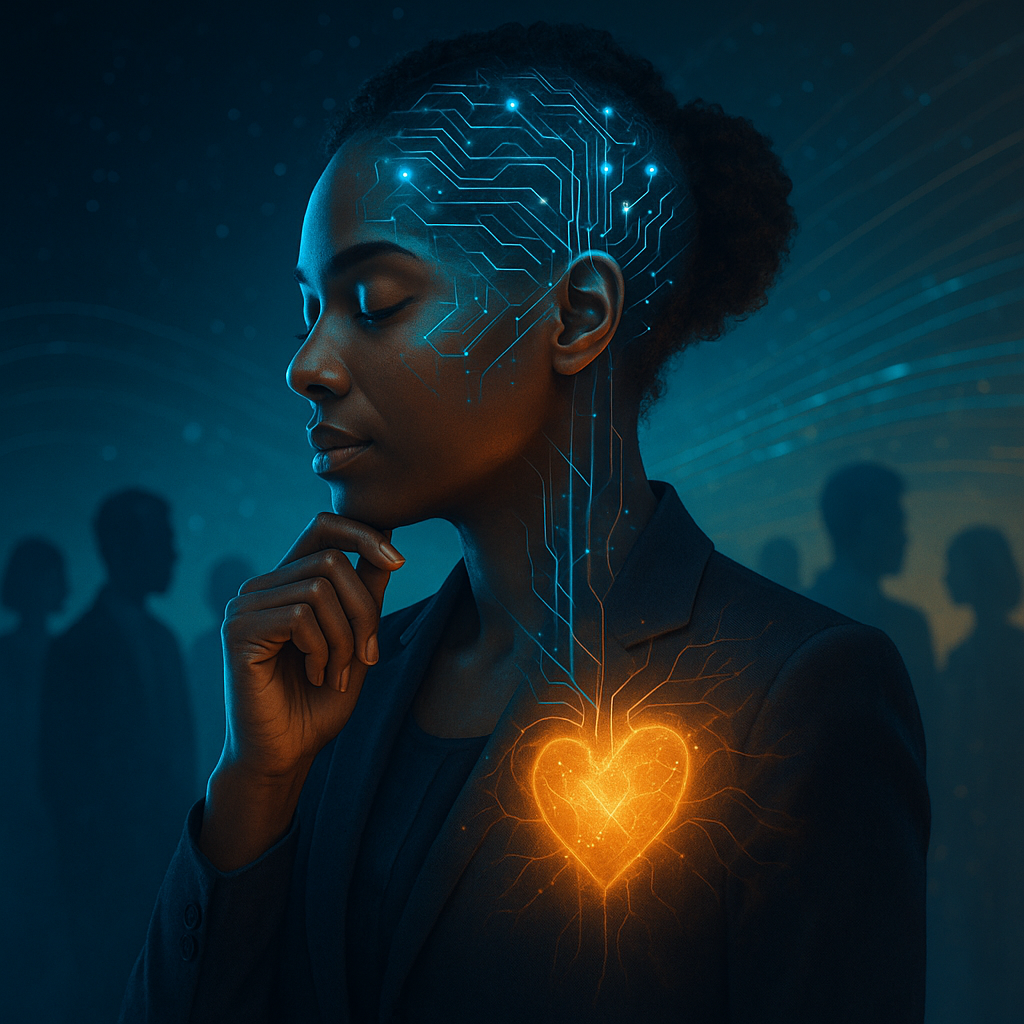
For years, conversations around artificial intelligence have focused on efficiency and speed. We’ve talked about automation, algorithms, and analytics. Yet the deeper question has always been human: how will AI change what it means to lead? AI is already handling much of what is predictable and procedural. But what remains, and what becomes exponentially more valuable, are the distinctly human capabilities that machines can’t replicate: empathy, inclusion, creativity, and trust. This is where emotional intelligence becomes the new strategic advantage, and it’s where the first part of what I call the Human Advantage Loop begins, a continuous cycle of awareness, empathy, inclusion, and trust that helps technology and humanity grow stronger together.
Awareness is the first turn in that loop. AI gives leaders dashboards filled with data, but emotional intelligence helps them interpret what those dashboards mean to people. Awareness is the ability to read the emotional climate behind the metrics. When a leader introduces new technology, the obvious questions tend to be what will it do and how will it help? But the hidden question that determines success is almost always emotional: how does this make people feel? Awareness is about sensing the human undercurrent the anxiety of losing relevance, the fatigue of constant change, or the quiet relief of finally having help with repetitive work. Leaders who can read those emotional signals prevent resistance from turning into disengagement.
In one organization I worked with, a department launched an AI tool designed to automate client reporting. On paper, it was a success. In practice, morale dropped. The team felt stripped of ownership and creativity. The turnaround came when the leader paused implementation to ask, “What’s worrying you most about this change?” That simple act of awareness opened a floodgate of insight. It wasn’t the technology they resisted, it was the loss of meaning. Awareness doesn’t require more meetings or more data. It requires presence. It’s the pause before reaction, the curiosity before conclusion. In a world of algorithms, awareness is the leader’s most human code.
If awareness is seeing what’s happening, empathy is caring enough to respond. It’s the bridge between information and connection, the ability to take another’s perspective and translate it into thoughtful action. Empathy in the age of AI isn’t sentimental. It’s strategic. When leaders approach change with empathy, they don’t just reduce resistance; they unlock innovation. People who feel seen bring forward better ideas, more quickly. Empathy also ensures that technology serves people, not the other way around. It challenges leaders to ask: who benefits from this system, and who might be left out? What new capabilities will our people need, and how can we support them through that transition?
A leader I coached reflected on this beautifully: “When we first introduced AI tools, our focus was on training people to use the technology. But what truly drove adoption was training managers to listen.” Her words capture the paradox of progress: the faster technology moves, the more vital listening becomes. Empathy in action looks like co-creation. It means inviting teams to shape how tools are used rather than dictating processes from above. It means acknowledging fears and frustrations instead of dismissing them as resistance. It’s about seeing emotional responses as data, equally important to any metric.
What’s becoming clear across industries is that AI doesn’t simply change how organizations work, it reveals how leaders lead. It acts as a mirror, reflecting the culture behind the technology. Leaders who rush implementation without empathy often encounter hidden backlash and compliance without commitment. Those who lead with awareness and empathy, however, find that trust and creativity naturally accelerate adoption. People move with you when they feel understood. Emotional intelligence, in this context, is not just a personal trait; it’s an organizational capability. It shapes how change is communicated, how fear is managed, and how inclusion is built into systems from the start.
When awareness and empathy are strong, they create a climate of safety, the soil from which inclusion and trust can grow. They turn uncertainty into curiosity, and resistance into participation. In every technological transition, leaders face a choice. They can focus on the system, or they can focus on the people who will bring that system to life. The leaders who thrive are those who start with the inner work, cultivating self-awareness, empathy, and emotional regulation before they design the outer change.
That’s why this first half of the Human Advantage Loop, awareness and empathy, represents the inner work of modern leadership. It’s the part that can’t be automated, outsourced, or faked. It requires humility, listening, and presence. The outer work, inclusion and trust, comes next. Those are the forces that turn insight into culture, and culture into sustained success. They’re the focus of the next article in this series, Inclusive AI Leadership: The Outer Work of Human-Centered Transformation.
The future of leadership won’t be defined by who best understands technology, but by who best understands people. AI will continue to evolve, but what will always set great leaders apart is the courage to stay deeply, intentionally human.
